
Summary: when comparing round or anatomical implants, the available evidence is more decisive than the usual debate suggests. In a blinded study published in Plastic and Reconstructive Surgery, thirty plastic surgeons and nurses were unable to tell which of the two shapes had been used when reviewing result photographs: they got it right about half the time, the same as flipping a coin. What genuinely changes the shape of your breasts is the volume, the profile, the surgical plane, and the quality of your tissues.
When you compare round or anatomical implants, the question that almost always comes up in my office is which one looks more natural. It’s a good question, and it has an answer that surprises most of my patients: in the final results, not even specialists can tell the difference.
For years, the anatomical implant — also called teardrop or drop-shaped — was presented as the sophisticated option, the one that reproduced the natural slope of a breast. It’s an intuitive idea, and a visually convincing one when you see the two implants side by side on a table. The problem is that an implant isn’t seen on a table: it’s seen inside a body, covered by tissue, upright and subject to gravity.
This article is what I explain to a patient who arrives convinced she needs one or the other.
What’s the Real Difference Between Round or Anatomical Implants?
Round implants have a circular base and distribute their volume evenly across the upper and lower halves. That doesn’t mean they produce a full or artificial-looking breast: the result depends on the profile chosen, the volume, the surgical plane and, above all, the tissue covering them.
Anatomical implants concentrate more volume in the lower pole. In theory, they reproduce the gradual slope of a natural breast: less fullness up top and more projection below. Their shape demands very precise placement, because their orientation does change the result.
So far, this is the description you’ll find on any website. The difference begins when we move from theory to what actually happens inside the body.
A round implant placed under the muscle and covered by sufficient tissue produces a very smooth upper transition. When you’re standing, gravity shifts the gel downward and the implant takes on a shape close to that of an anatomical one. An anatomical implant, on the other hand, doesn’t guarantee a natural look if the volume is miscalculated or doesn’t match the patient’s proportions.

What Does the Evidence Say About Which One Looks More Natural?
This is where the debate stops being a matter of opinion.
The American Society of Plastic Surgeons reported on a blinded study, published in Plastic and Reconstructive Surgery, in which thirty plastic surgeons and nurses reviewed before-and-after photographs of thirty women who had undergone surgery: fifteen with round implants and fifteen with anatomical implants. All of the procedures used silicone implants placed in the submuscular plane, with an average volume of around 300 cc.
The task was simple: identify which type of implant had been used in each case.
The result was an accuracy rate of roughly 50 percent. In other words, chance. And agreement was poor both between different raters and within the same rater reviewing the same images weeks later. The authors concluded that the popularity of the anatomical implant finds no justification in the aesthetic result — especially considering that it costs more and adds the risk of rotation.
When Might an Anatomical Implant Make Sense?
I’m not saying the anatomical implant has no indication. I’m saying its indication is narrower than its reputation suggests.
It can offer real advantages in reconstructive surgery, where a breast shape has to be rebuilt from significantly altered anatomy and the implant’s design does work the tissue can no longer do. It can also help in selected cases of aesthetic augmentation with very little breast tissue and a particular chest anatomy.
Outside those scenarios, in a patient with sufficient tissue seeking aesthetic augmentation, the evidence doesn’t support paying more and taking on the risk of rotation to obtain a result no one can distinguish.
If a surgeon proposes an anatomical implant, it’s reasonable to ask exactly why in your case — and to expect an answer that goes beyond “it looks more natural.”
What Actually Does Change the Shape of Your Breasts?
If the implant’s shape matters less than you thought, it’s worth knowing what really does.
The volume. The same number of cubic centimeters looks completely different depending on the width of your chest. The cup size you want isn’t something that translates directly into cubic centimeters.
The profile. Low, moderate, high, or extra high. At the same volume, the profile determines how far the implant projects forward and how much base it occupies. It’s the variable that most influences whether the upper pole shows or not.
The surgical plane. Above the muscle, under the muscle, or dual plane. It affects upper pole coverage, the visibility of the implant edges, how the implant moves when you contract the pectoral muscle, and your recovery. A patient with little upper tissue benefits from additional coverage; another with good tissue and an active sporting life may need a different strategy.
Your own tissues. The quality and thickness of your skin, your existing breast volume, the position of your inframammary fold, the distance between your breasts, and the asymmetries you already have. This is assessed during your consultation.
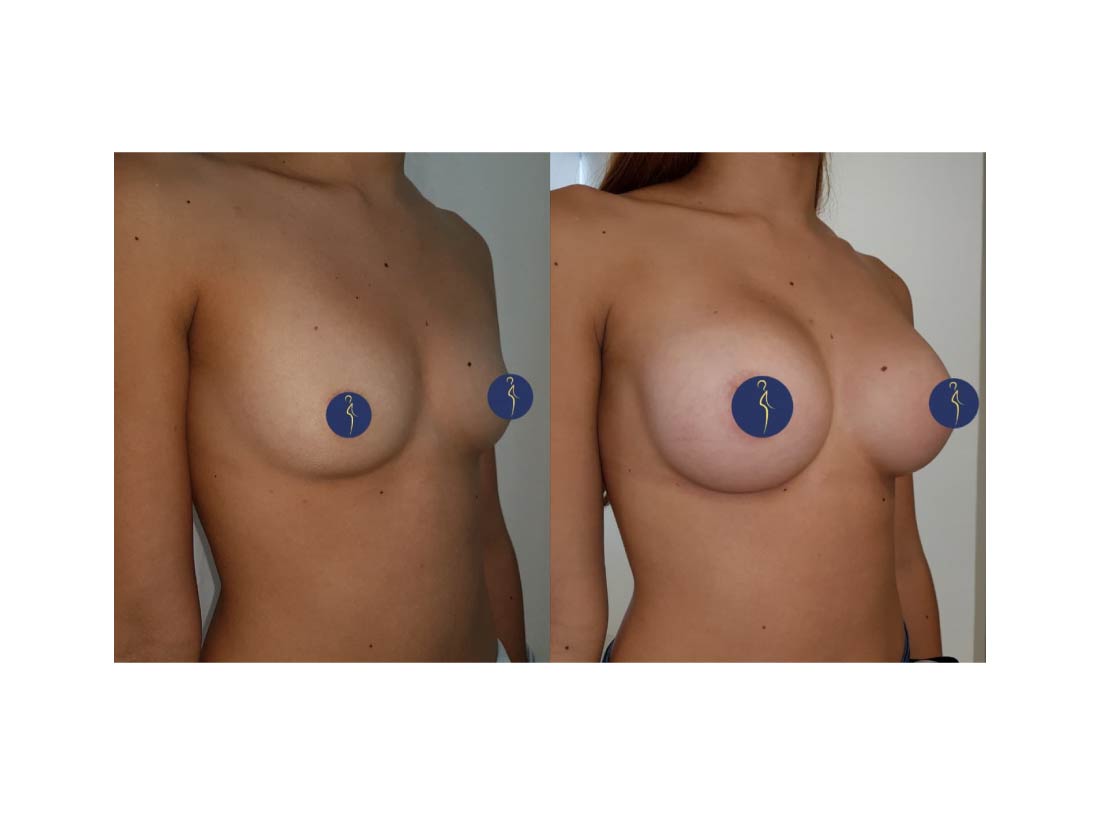
And What If I Also Have Sagging?
When there’s significant ptosis, or breast sagging, placing an implant increases the volume but doesn’t necessarily correct the position of the nipple-areola complex. The result can be a larger breast that still sags — and a patient who doesn’t understand why.
In those cases, the honest recommendation is usually to add a mastopexy, or breast lift, which involves a different pattern of scars and more time in the operating room.
Frequently Asked Questions
Do anatomical implants look more natural than round ones? The available evidence doesn’t support it. In a blinded study, thirty specialists were unable to tell which type of implant had been used when reviewing result photographs; they got it right about half the time.
Why are anatomical implants textured? Because they need to hold their orientation. The texture adheres to the surrounding tissue and keeps the implant from rotating inside the pocket — something that would be irrelevant with a round implant, since its shape is symmetrical.
What happens if my anatomical implant rotates? The visible shape of the breast changes. It requires evaluation and, often, surgery to reposition it. It’s a complication specific to this type of implant that the round one simply doesn’t have.
So which one is right for me? In most aesthetic augmentations, a round implant with the right profile and plane. The definitive answer depends on your anatomy and is determined during your consultation.
How much should price weigh in the decision? Anatomical implants usually cost more. That only matters if they give you something in return; if the result is indistinguishable, the extra cost doesn’t buy anything.